

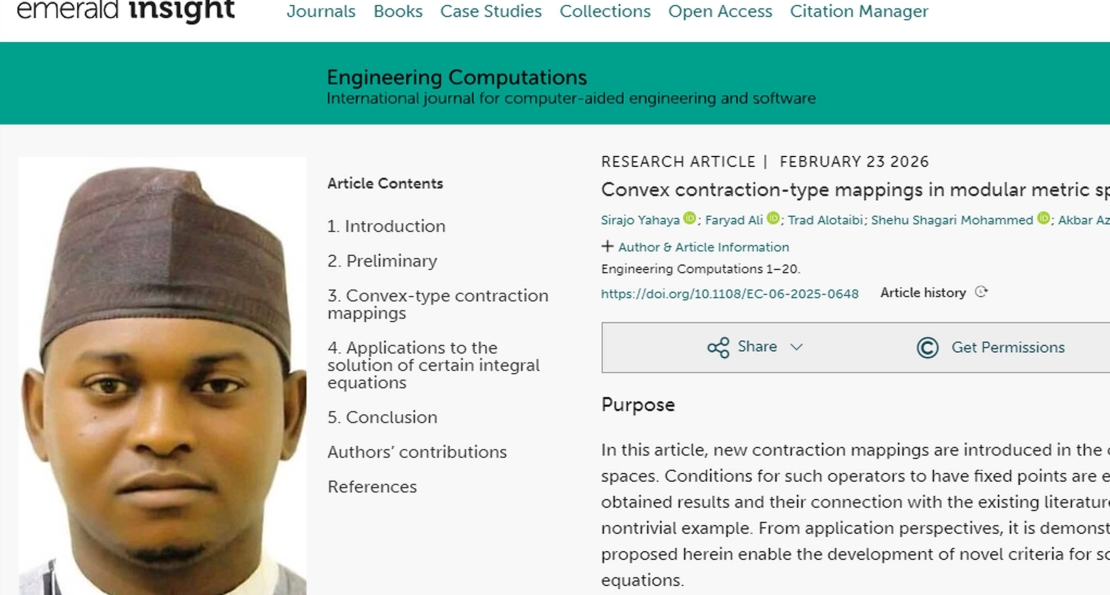
The American University of Nigeria (AUN) is making waves in international academia. Dr. Sirajo Yahaya of the School of Arts & Sciences has led a pioneering team of researchers from Nigeria, Saudi Arabia, and Pakistan in a study that promises to transform the way complex engineering and scientific problems are solved.
Published recently in the Journal of Engineering Computation, the study explores modular metric spaces, a mathematical framework designed to find stable solutions to challenging equations commonly used in physics, computing, and engineering.
“Our work extends fixed-point results to broader contexts, showing how these principles can solve integral equations more effectively,” the research team explained.
At the heart of the study are fixed points, solutions that remain unchanged even after repeated calculations. These mathematical constants are essential for modeling real-world systems, from heat distribution in materials to data flow in computer networks. Using established techniques like Picard iteration, the team demonstrated that their approach reliably produces accurate results, even providing a concrete example to validate their theory.
This research reinforces AUN’s identity as a development-focused university where scholarship meets practical impact. By advancing mathematical theory with direct applications in engineering and computing, Dr. Sirajo’s work highlights how Nigerian researchers are contributing to global scientific progress.
The implications are far-reaching. Beyond mathematics, these breakthroughs could inform innovations in technology, energy systems, and medical devices.
By building on decades-old mathematical ideas and introducing fresh insights, the study also illustrates how cross-border collaboration can amplify Nigeria’s presence in the international research community.
Read the full study here
Reported by John Abah