

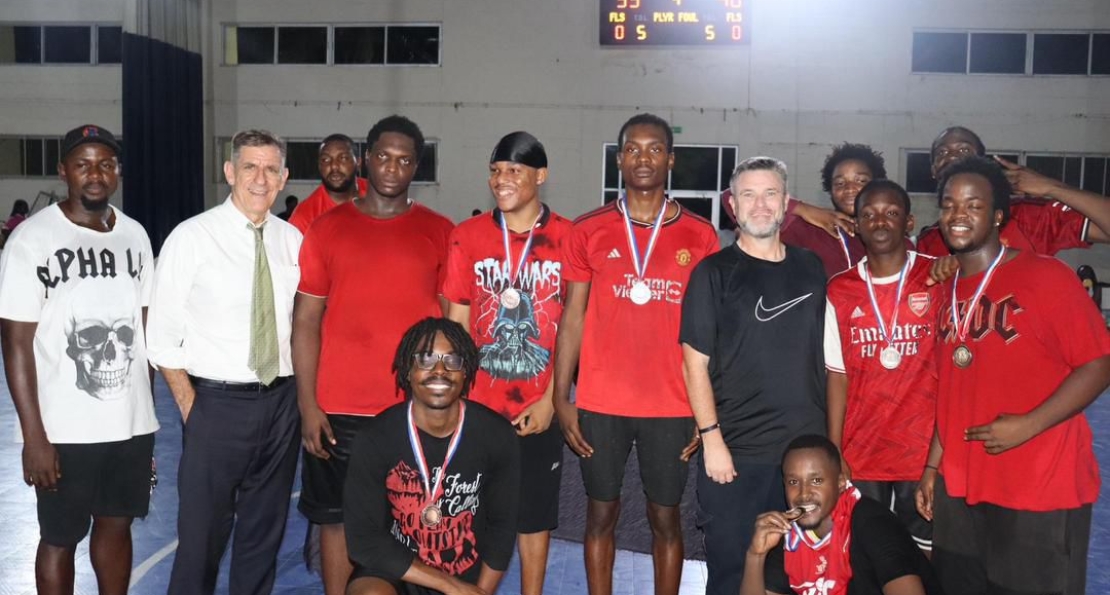
The American University of Nigeria’s 2026 Olympics recently concluded after a week of spirited competition that brought together students from across the university in a celebration of athletic excellence, school pride, and campus unity.
The weeklong tournament transformed everyday campus spaces into vibrant arenas of competition and student engagement. Events included badminton, basketball, volleyball, football, table tennis, dodgeball, and track and field, drawing participation from students representing the School of Information Technology and Computing (SITC), School of Arts and Sciences (SAS), School of Engineering (SOE), School of Business and Entrepreneurship (SBE), School of Law (SOL), and School of Basic Medical Sciences (SBMS).
From intense rivalries on the court to moments of camaraderie in the stands, the Olympics reflected the growing role of sports in shaping student life at AUN while strengthening the sense of community across academic schools.
Ekemini, a junior Computer Science student who served both as an organizer and an athlete, explained that this year’s Olympics was intentionally structured around competition among academic schools rather than individual departments, with the goal of deepening school identity and fostering stronger student communities. “The vision was to get schools to compete against each other because AUN is more about schools than departments,” he said.
According to Ekemini, preparations for the event began as early as the previous semester, with organizers working to coordinate schedules and streamline the structure of the games. Still, he acknowledged that execution came with its own challenges. “Sometimes communication is not clear, and during the Olympics some events clash. What is planned is not always what happens, and that can be disappointing,” he explained.
Despite these challenges, he said the format helped strengthen students’ sense of belonging within their respective schools.
In addition to his role as an organizer, Ekemini also competed in basketball and volleyball, describing his preparation as both demanding and necessary. “I’ve been going through intense training. You have to keep participating so you don’t get injured and stay ready,” he said.
For many students, however, the Olympics was equally about connection, relaxation, and enjoyment. On the basketball court, Djibril Mashariki, a senior majoring in Computer Science, described his approach to the tournament as more relaxed, focusing less on preparation and more on the experience itself. “I haven’t really been preparing at all. This is my first game,” he said.
For Djibril, the value of the Olympics extended beyond competition. “It’s about having fun with my friends, playing a sport I enjoy, and just mentally relaxing.”
While basketball drew visible excitement and larger crowds, experiences in other sports reflected a different level of intensity.
Princewill Asogwa, a junior majoring in Software Engineering and competing in badminton, described a more demanding routine and a quieter competitive environment. His training schedule began as early as 6 a.m. each day in preparation for the tournament. “I had to train every morning around 6 a.m.,” he said.
Although he observed that badminton attracted fewer spectators than some of the more crowd-driven sports, his motivation remained firmly rooted in personal achievement and the pursuit of excellence.
The tournament also highlighted standout performances across schools, with students and supporters rallying behind their teams throughout the week and contributing to the vibrant atmosphere that defined the games.
As the AUN Olympics 2026 came to a close, the tournament proved to be more than a series of athletic contests. It served as a reflection of student resilience, school spirit, and the vibrant culture of participation that continues to define campus life at AUN.
Beyond medals and trophies, the games showcased how students shape the energy and meaning of the AUN experience, through competition, support, and a shared sense of community.
Reported by Michelle Ikpaanyam