

In an era where information is one of the most valuable assets of any organization, institutions that fail to manage their data effectively risk inefficiency, poor decision-making, and loss of credibility. At the American University of Nigeria (AUN), however, a different narrative is emerging—one that places people, data integrity, and digital competence at the core of institutional growth.
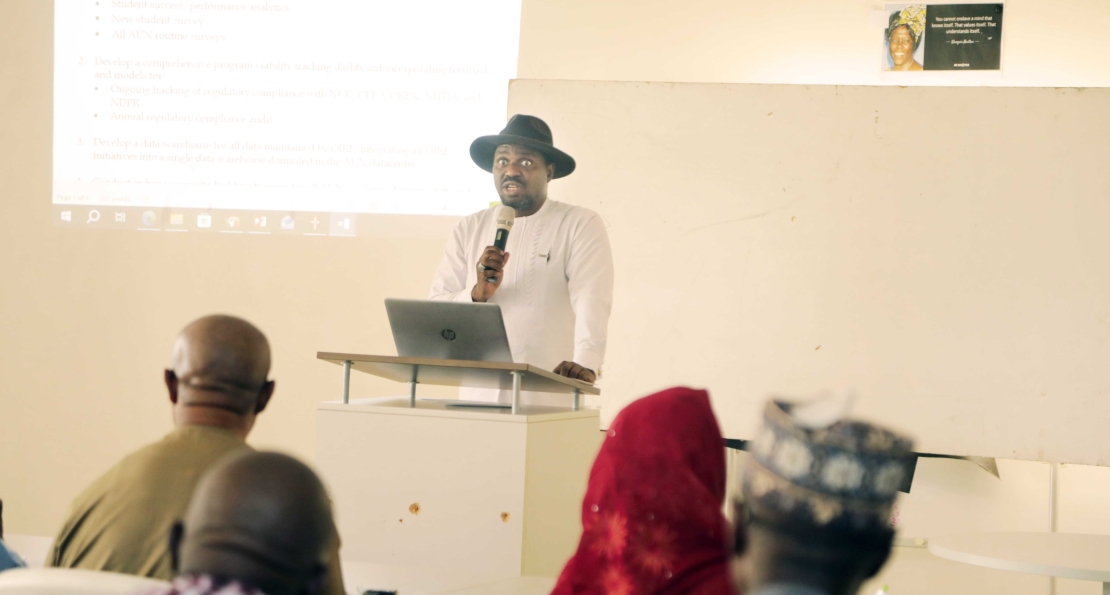
Recently, staff members from across the university gathered at the 24-Hour Room of the AUN Library for a Data Governance and Google Workspace Workshop organized by the Human Resources and Planning Department. The four-hour session was a strategic initiative aimed at strengthening administrative efficiency, safeguarding institutional data, and preparing staff for the demands of a modern, data-driven workplace.
As universities increasingly rely on digital records for planning, reporting, compliance, and service delivery, effective data management has become essential. From student records and personnel files to financial reports and departmental documentation, data supports every layer of institutional operations. The workshop addressed this reality by helping participants understand what data is, why it matters, and how it should be responsibly managed to ensure accuracy, security, and continuity.
Speaking on data and data integrity, Mr. Alvin Forteta, Director of Institutional Research and Effectiveness, translated complex concepts into practical insights that resonated with participants. He explained that data goes beyond numbers or files stored on computers; it directly shapes institutional decisions, policy formulation, and public perception. Poor data practices—such as inconsistent record-keeping, duplication, or inaccuracies—he warned, can result in flawed reporting, ineffective planning, and reputational damage. In contrast, strong data integrity promotes efficiency, accountability, and evidence-based decision-making.
Mr. Forteta challenged participants to see themselves not merely as administrative staff, but as data custodians whose daily actions collectively determine the reliability of the university’s information systems.
This focus on integrity was complemented by a practical examination of record management in offices where paper files, shared drives, and digital tools coexist. The session was led by Mr. Omachi Okolo, Assistant Director of Information and Digital Literacy, who presented “The Living Archive: Paper Files, Shared Drives, and Departmental Continuity.”
Mr. Okolo addressed a challenge familiar to many Nigerian institutions, fragmented records spread across filing cabinets, personal computers, flash drives, and poorly organized shared folders. Such practices, he noted, often lead to lost information and operational disruptions, particularly when staff transfer, retire, or leave their roles. Describing institutional records as “living archives,” he emphasized that documentation should be treated as dynamic resources that support continuity and institutional memory rather than static storage. Participants were guided through best practices for organizing paper records, structuring shared drives, and using Google Workspace tools to ensure secure and accessible information flows.
The sessions resonated with participants, many of whom acknowledged that improved record-keeping would ease daily tasks and reduce dependence on individuals rather than systems.
One of the workshop’s defining strengths was its inclusiveness. Participants included Administrative Assistants, Executive Assistants, Office Managers, Administrative Officers, Assistant Managers, and Managers, reflecting AUN’s recognition that institutional effectiveness depends on aligned practices at every administrative level. Staff members outside these roles who expressed interest in the training were also welcomed.
Beyond technical skills, the workshop had a noticeable impact on staff confidence and morale. In many Nigerian workplaces, limited access to structured professional development can leave employees feeling unprepared or undervalued. At AUN, staff development is a priority, and employees are trusted partners in institutional progress.
Mrs. Faiza Abubakar, Assistant Vice President of Human Resources, noted that such empowerment often leads to improved service delivery, stronger compliance, and healthier workplace relationships. When staff understand the significance of their responsibilities, she observed, they are more likely to take ownership and show initiative.
Speaking on the success of the initiative, the President of the American University of Nigeria, Prof. DeWayne Frazier, commended the Human Resources and Planning Department and all units involved, describing the university’s professional development culture as unmatched within Nigeria and beyond. “I cannot imagine another university in Nigeria or even on the African continent with the level of professional development opportunities we provide for our faculty and staff,” he stated. According to the President, the workshop forms part of a broader, intentional strategy to build human capacity across the institution.
He highlighted AUN’s sustained investment in structured development programs such as Academic Impressions, the Teaching and Learning Center, the Employee Monthly Awards, and other initiatives spanning academic and non-academic staff. These programs, he explained, are designed to enhance technical competence while fostering leadership, innovation, accountability, and institutional ownership. “Our goal,” he added, “is to ensure that every member of staff, regardless of role or rank, has access to opportunities that help them grow professionally and contribute meaningfully to the university’s mission.”
Describing the workshop outcomes as impressive, the President praised the quality and relevance of the sessions, noting that initiatives like these strengthen institutional effectiveness and position AUN as a model for higher education in Africa. “Well done,” he concluded. “These reflect the standard of excellence we strive to maintain as a university.”
Reported by Pwagreno Blessing Moris