

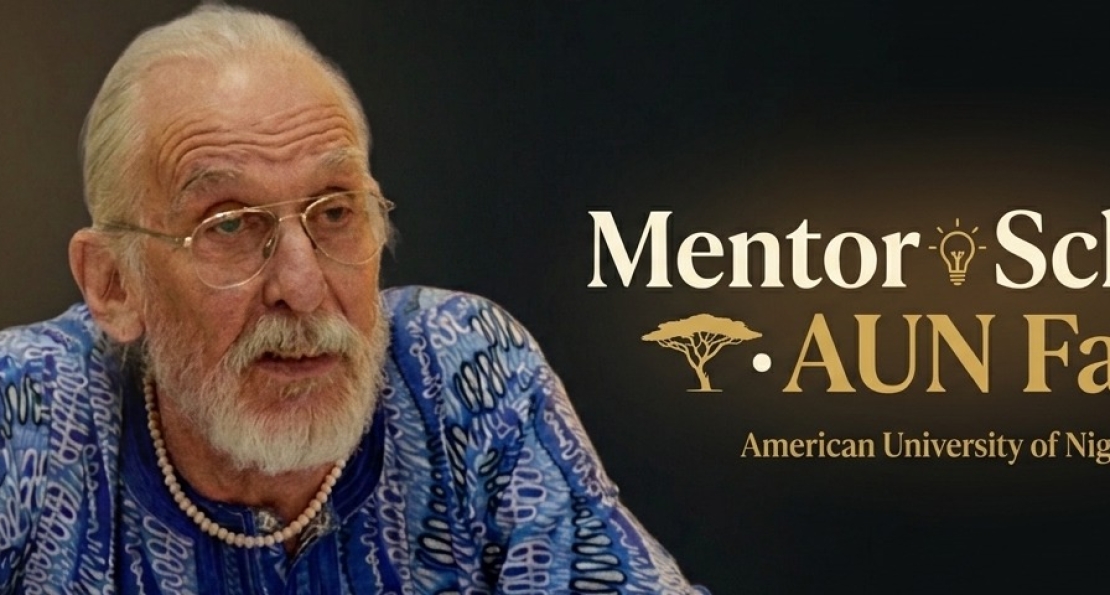
AUN Pays Tribute to Founding Faculty Member Professor Bill Hansen, a Scholar and Mentor
The American University of Nigeria (AUN) has lost one of the architects of its academic foundation with the passing of Professor Bill Hansen, a pioneering scholar, mentor, and founding faculty member whose influence helped shape the institution from its earliest days. Hansen passed away on June 13, 2026, at the age of 86, leaving behind a legacy that continues to inspire generations of students, colleagues, and educators across the world.
Born in Cincinnati, Ohio, Professor Hansen devoted his life to scholarship, teaching, public service, and the pursuit of justice. Over a career that spanned decades and continents, he distinguished himself as a respected political scientist, a courageous advocate for human rights, and an educator whose impact transformed countless lives.
For the American University of Nigeria, however, his legacy is especially profound. As one of the university's pioneering faculty members, Hansen helped lay the intellectual and institutional foundations upon which AUN was built. His influence continues to resonate in the university's academic culture, commitment to excellence, and dedication to developing future leaders.
To students, he was a demanding but inspiring teacher. To colleagues, he was a trusted mentor and friend. To the institution he helped build, he was a guardian of academic standards and a champion of the transformative power of education.
Professor Hansen was among the earliest faculty members recruited to help establish the American University of Nigeria in Yola. At a time when the idea of creating a world-class American-style university in northeastern Nigeria seemed ambitious to many, Hansen embraced the challenge with characteristic conviction and enthusiasm.
Reflecting on his passing, AUN Founder and former Vice President of Nigeria, His Excellency Atiku Abubakar, described Hansen as one of the institution's most important pioneers. "Dr. Hansen's tenure with AUN was marked by uncommon devotion to education and a pioneering spirit that helped lay the foundation for the university's mission to foster global understanding through learning and service," Atiku said. "He embodied the best of a scholar: rigorous in thought, generous in mentorship, and steadfast in kindness."
According to the Founder, Hansen's contributions extended far beyond teaching. He played a pivotal role in curriculum development, academic planning, faculty mentorship, and establishing the culture of intellectual inquiry and integrity that remains central to AUN's identity. "His classrooms were places where questions were welcomed, where students learned to think critically and compassionately, and where the value of integrity was demonstrated through action," he added.
AUN's founding president, David Huwiler, described the loss as deeply personal. "Today I lost the guy who has been my best friend for more than 26 years," Huwiler wrote in an emotional tribute.
Their friendship began at the American University of Central Asia in Bishkek, Kyrgyzstan, before they embarked on the journey of building AUN together. "When I was asked to move to Yola to build the American University in Nigeria, he was the first person I hired," Huwiler recalled.
Hansen quickly became one of AUN's most persuasive ambassadors. Travelling across Nigeria, he met prospective students and parents, helping them understand the vision behind the new university. "It was Bill who went on the road to talk with students and families across Nigeria," Huwiler wrote. "After ten minutes with Bill, it was obvious to these families that this would be a serious university."
While Hansen was widely admired as an educator and institution-builder, he was equally respected as a scholar whose work addressed some of Africa's most pressing challenges.
As Chair of AUN's Department of Politics and International Studies, he helped shape one of the university's most influential academic programs while mentoring generations of students and young scholars.
His research focused on governance, political violence, insurgency, conflict resolution, and state-society relations, with particular attention to the factors that contributed to the emergence of Boko Haram in northeastern Nigeria.
Through years of scholarship and public engagement, Hansen argued that social inequality, weak governance, economic marginalization, and institutional failures played significant roles in creating the conditions that allowed violent extremism to flourish. His work challenged simplistic narratives about insurgency and encouraged policymakers and researchers to address the deeper structural causes of conflict.
Among his most notable contributions were studies examining Boko Haram, governance deficits, political violence, and the complex relationship between citizens and the state in Nigeria. His research became widely referenced in discussions on peacebuilding, security, and development across the Lake Chad Basin region.
Recognized internationally for his expertise, Hansen participated in several collaborative research initiatives and policy dialogues. He served on the steering committee of a major Canada-funded research project examining Boko Haram and regional security challenges in the Lake Chad Basin, bringing together scholars and practitioners from across Africa and beyond.
Students often remembered Professor Hansen's courses as some of the most challenging offered at AUN. Yet many also described them as among the most rewarding and transformative experiences of their university education.
AUN President Dr. Dewayne Frazier noted that Hansen's demanding standards left a lasting impact. "Many students have shared that they were among the best and most meaningful courses they took during their time at AUN," Frazier said. "His dedication to teaching and his impact on generations of students will not be forgotten."
Farouk Abubakar Tenimu, a former student, described his courses as among the most challenging experiences of his academic life. "His class at AUN was the toughest I ever took, one of the hardest things I had to pass. But those demanding lessons stayed with me long after. He said, Prof., you left a real mark," he concluded.
Tenimu's tribute reflects the experience of many AUN graduates who, despite the rigor of Hansen's classes, came to appreciate the lasting value of the discipline, critical thinking, and intellectual resilience he instilled.
As news of Hansen's passing spread, tributes poured in from former colleagues, students, and friends across the world.
Former faculty member Aghileh Djafari Marbini recalled the kindness Hansen showed when she first arrived in Yola. "I arrived in Yola, slightly shell-shocked after a 24-hour journey from London. William Hansen took me under his wing and made me feel welcome," Marbini wrote. "We argued fiercely and laughed hard. Rest in power, my friend."
Her words reflected a common theme among those who knew him. Hansen possessed a rare ability to engage passionately in intellectual debate while maintaining deep friendships grounded in mutual respect and affection.
Benjamin Musa, one of AUN's longest-serving staff members, described Hansen as a source of inspiration whose influence transcended the university. "Professor Hansen's wisdom, integrity, and passion for excellence touched countless lives," Musa said. "He inspired generations through his teachings, leadership, and commitment to academic and personal growth."
As condolences continue to arrive from alumni, faculty members, scholars, and friends around the world, one message remains constant: Professor Bill Hansen's influence did not end with his passing.
His ideas live on in the research he produced. His values endure in the hundreds of students he taught and mentored. His example continues to inspire colleagues and educators committed to academic excellence, ethical leadership, and public service.
AUN Founder perhaps captured the essence of Hansen's life most poignantly. "We are reminded that a university is more than brick and mortar; it is the people who lend their hearts and minds to a common purpose. Dr. Hansen's life stands as a testament to what is possible when intellect is paired with compassion."
Professor Bill Hansen leaves behind not only a distinguished academic legacy but also a powerful reminder that education, at its best, is an act of service to humanity.
For AUN Bill was a scholar of distinction, a mentor of uncommon dedication, an institution builder, and a guardian of academic excellence. Though his voice is now silent, the institution he helped build stands as one of the most enduring monuments to his life's work.
May Professor Bill Hansen rest in eternal peace.