

In the quiet corridors of Dorm AA at the American University of Nigeria, a quiet revolution has been unfolding. It is the work of a young woman who has transformed the lives of ten schoolgirls she may never meet.
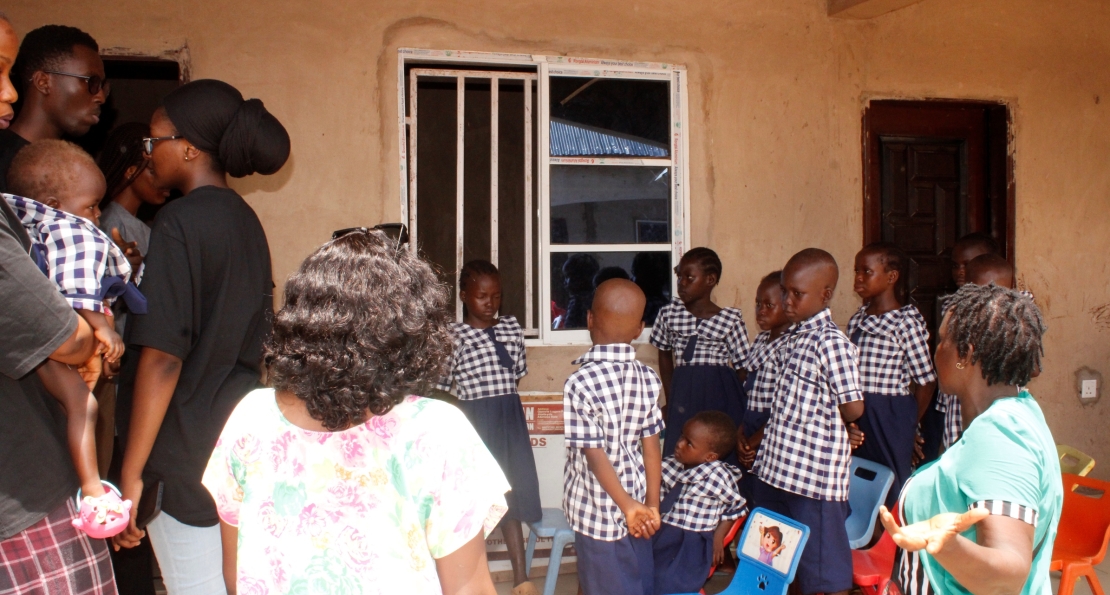
Rebecca Neni, a Senior, Chemical Engineering student, doesn’t wear her impact on her sleeve, but the numbers tell the story. As a Resident Assistant and Head of Tutorials for the AUN Honors Society, has helped provide school uniforms, paid school fees, and renovated classrooms for Sanda Girls School in Yola. Her dorm now ensures ten girls receive educational sponsorship regardless of the semester, while hundreds of students across campus have regained academic confidence through the tutorial program she leads.
For AUN, christened as “Africa's first development university," Rebecca embodies a mission that goes far beyond textbook learning. At AUN, where liberal arts education meets Sub-Saharan Africa’s development needs, students like Rebecca are living proof that the approach works.
When Rebecca first arrived at AUN, she already had a natural inclination toward service, but the university taught her to channel that instinct into structured, meaningful impact. “I have always enjoyed giving back to the people around me,” she reflects. “Wherever I find myself, I make a conscious effort to support and serve others in whatever way I can.” At AUN, community service is not just extracurricular; it is a core part of the university’s identity. Through her roles as Resident Assistant and Head of Tutorials, Rebecca turned instinct into sustained, measurable change.
In Dorm AA, service became both local and far-reaching. Each spring, residents pool contributions to identify schools in need, and Sanda Girls School became their consistent partner. “Through these initiatives, we have provided uniforms, paid school fees, and renovated classrooms,” Rebecca explains. What began as a semester project evolved into an enduring commitment. Simultaneously, as Head of Tutorials, she coordinates academic support across campus, where “we have tutored hundreds of students and helped restore confidence and hope to those struggling.” Student testimonies remain her most powerful motivation.
While chemical engineering may seem disconnected from community service, Rebecca sees her technical training as fundamental to her work. “My major requires constant engagement with mathematics, calculations, and structured problem-solving,” she explains. “Over time, this has helped me develop a sharp and analytical mindset, which I apply beyond the classroom.” This approach aids her tutoring and project planning alike, from breaking down complex problems to organizing resources efficiently.
Her CDV coursework gave her a deeper intellectual framework for her community work. In CDV 211, Law and Justice in Development, she studied equity, governance, and human rights, with a focus on children’s rights. “This course helped me see that education is a fundamental human right, not a privilege,” she says. Understanding this distinction transformed her perspective: uniform donations and fee payments became acts of educational justice rather than mere charity, fueling her passion for long-term impact.
Yet Rebecca admits her most profound lessons have come outside the classroom. “Real impact goes beyond theory, grades, or technical knowledge,” she says. “Working directly with people has taught me empathy, patience, and responsibility in ways no lecture ever could.” Each student she tutors, each resident she supports, brings a unique story and pace of learning. “This has taught me to listen actively, adapt my approach, and meet people where they are—skills that cannot be fully taught in a classroom.”
These skills were tested when navigating conflicts among residents from diverse cultural, religious, and social backgrounds. “There were moments where both parties believed they were right, making resolution difficult,” she recalls. Rebecca learned that “effective problem-solving requires understanding context; what may seem minor to one person could be deeply significant to another.” Her approach now centers on listening without assumptions and approaching every issue with empathy and neutrality—lessons that extend to her tutorial work, where students of varying confidence levels require adaptable communication.
Such commitments come with personal cost, and Rebecca is candid about it. “It is stressful and draining,” she admits. Whether planning projects or tutoring in limited free time, the investment is substantial. Yet she finds fulfillment outweighs fatigue. “The impact on people’s lives makes every effort meaningful.”
These formative experiences have reshaped her vision for the future. Initially drawn to Chemical Engineering for its rigor, she now sees her path incorporating both analytical skills and people management. “My experiences in community service and student leadership have shaped how I see my future, professionally and as a citizen,” she explains. Coordinating students, resolving conflicts, and planning initiatives revealed that effective leadership requires understanding people, systems, and processes simultaneously. These insights strengthened her interest in industrial and organizational management: “Even the best systems only succeed when the human element is managed well.” Her vision now blends technical expertise, management skills, and social responsibility—the very ethos her CDV courses helped articulate—to create environments where people can thrive.
As Rebecca prepares to graduate, she carries not just a degree in Chemical Engineering, but a profound understanding of leadership shaped equally by classroom learning and hands-on service. “Leadership is rooted in service,” she reflects. “Being responsible for others has taught me that leadership is less about position and more about responsibility, humility, and impact.”
“Going forward,” she says with quiet conviction, “I envision myself in roles where I can combine technical expertise, management skills, and social responsibility to create environments where people can thrive.” For a young woman who learned at AUN that education’s highest purpose is service to others, and who has already created such environments during her university years, there is every reason to believe she will do the same wherever she goes next.
Reported by Udoh Victoria Clement