

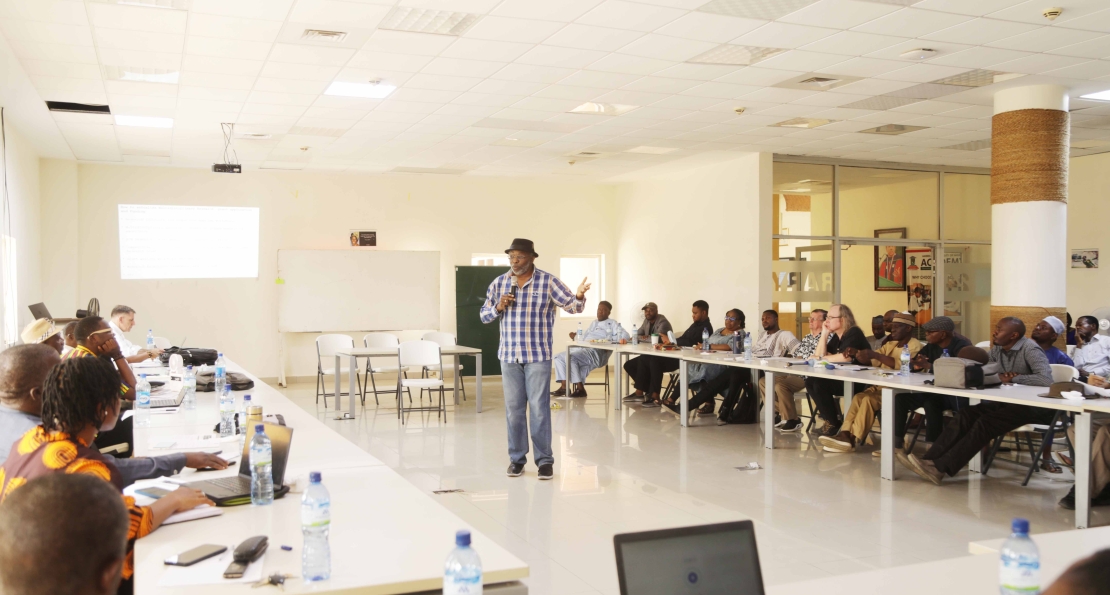
In a strategic move to boost research output and foster interdisciplinary collaboration, the Teaching and Learning Centre (TLC) at the American University of Nigeria (AUN) convened faculty from diverse disciplines for an intensive grant writing workshop on 20 February 2026. Held in the university’s 24-hour library, the session aimed to translate theoretical knowledge into actionable research proposals.
Moderated by Prof. George Ani, the workshop highlighted the importance of cross-disciplinary collaboration. “With the evolving demands on universities, faculty must adapt, innovate, and explore opportunities beyond traditional funding systems,” he said.
Prof. Malachy added, “Grants are more than financial support; they are catalysts for growth. They strengthen faculty expertise, enhance departmental capacity, and elevate the university’s global standing. Effective grant writing requires vision, collaboration, and strategic thinking.”
To simulate real-world research dynamics, participants were grouped across disciplinary lines. Mathematicians collaborated with health scientists, educationists with computer scientists, and social scientists with environmental researchers. Their task was to identify shared research interests and map collective strengths through focused brainstorming sessions.
What followed was a masterclass in rapid ideation. One team of mathematicians and health scientists developed a proposal titled “Conformal Mapping in AI-Driven Models in Health Care”. Their concept targets breast cancer detection in underserved communities in the North East, integrating advanced mathematical modeling with artificial intelligence to improve early diagnosis. Discussions were animated as equations met epidemiological data, with the group refining algorithms for practical implementation in low-resource clinics.
Another team combined mathematics, public health, and community studies to create “Numerical Methods for the Prevention of Infectious Diseases in Hausa/Fulani Communities”. The discussion emphasized culturally responsive epidemiological models, highlighting the importance of engaging traditional leaders while developing predictive frameworks for disease prevention.
A third group, comprising educationists, computer scientists, and humanities scholars, focused on “Using Complete Animation to Map African Indigenous Wisdom in Peacebuilding, Health, and Literacy Skills.” They explored archiving oral traditions through animated narratives and designing interactive platforms for classroom delivery, demonstrating scholarship with a visual and engaging dimension.
Finally, a team of environmental scientists and policy researchers addressed a national concern with “Measuring the Socio-Economic Burden of Neglected Tropical Diseases in Nigeria: Implications for Policy.” Their dialogue ranged from disease prevalence data to fiscal policy implications, identifying gaps in health interventions and proposing evidence-based advocacy strategies. At the end, abstract disciplinary interests had crystallized into structured, fundable research concepts.
In her vote of thanks, Prof. Agata Ukata praised the faculty’s engagement, commended Prof. Ani for his seamless moderation, and thanked Prof. Malachy for demystifying the grant writing process, making it practical and actionable for all participants.
Reported by Udoh Victoria Clement