

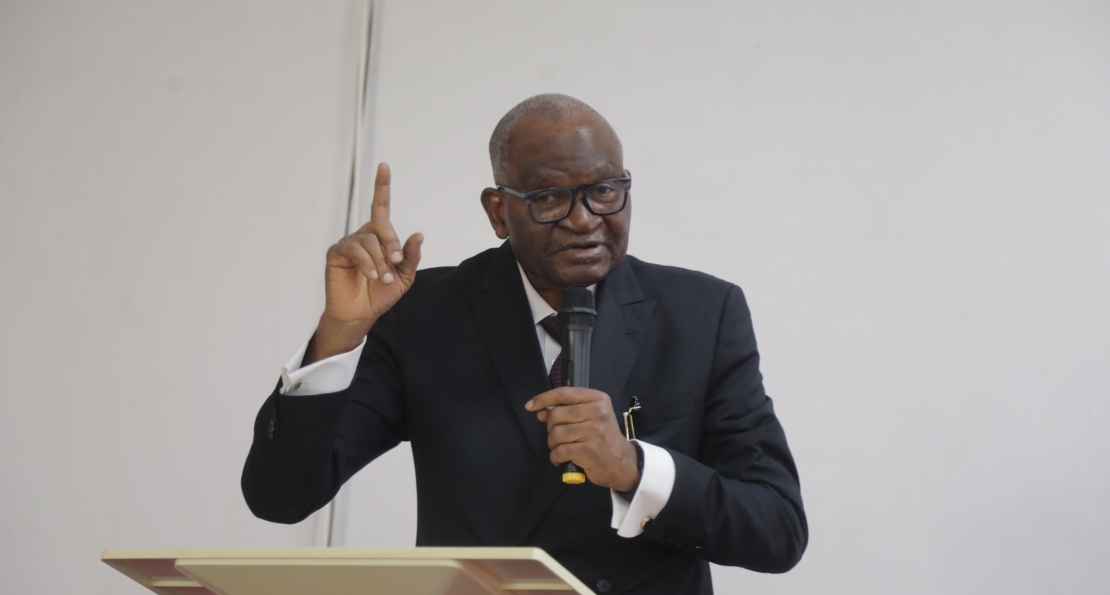
The American University of Nigeria (AUN) School of Law, on 20 February 2026, hosted one of Nigeria’s most distinguished legal minds, Chief Dr. Kanu Agabi, CON, SAN, who delivered a searing critique of the nation’s corrupt practices. He declared that law alone cannot save the country without a fundamental return to morality and God. The lecture, part of the AUN School of Law Lecture Series, drew a packed audience of students, faculty, and dignitaries to the School of Law Auditorium.
Chief Agabi, a former Attorney General of the Federation and Minister of Justice, former Senator, and Senior Advocate of Nigeria, addressed corruption with the passion of a politician, the precision of a legal practitioner, and the wisdom of an elder statesman. “I am grateful to the people of the American University of Nigeria for the privilege of delivering this speech on the subject of corruption in our country,” Agabi began, following a warm welcome from the Dean of the School of Law, Prof. Bello Magaji. He quickly moved beyond formalities into a profound discourse, arguing that the fight against corruption cannot be won through legislation alone.
Drawing on over 54 years of legal practice and his experience as Attorney General, he admitted, “As Attorney General, I put the emphasis on morals. People said, ‘You are the Attorney General; put the emphasis on law.” And I said, “law has failed the nation. That is where we still are even now. Law continues to fail the nation. We must return to the Lord.”
Agabi lamented what he called the troubling silence of the legal profession in the face of national decline, noting that it has come “under justifiable suspicion of being implicated in the wrongdoings that now imperil the nation.” He added, “a time will never come when the nation shall be completely transparent, but we should never reconcile with corruption. It will always be illegal and unlawful. Our duty is to oppose it with our hearts, with our mouths, and best of all, with our hands.”
Reflecting on Nigeria’s history of colonialism and military rule, Agabi observed that the nation’s collective conscience has been “hardened and brutalized,” making dishonesty increasingly normalized across institutions, including the legislature and clergy. While wrongdoing may go unpunished in the short term, he warned that moral failure ultimately yields no reward. He challenged the younger generation to preserve their sense of shame, describing it as their “defense” in a world that often glorifies shamelessness. “Hold on to your sense of shame. Your sense of shame is your defense.”
Weaving together scripture, philosophy, and personal anecdotes, Agabi stressed the universal principle of reaping what one sows. He traced Nigeria’s crisis to a dangerous illusion that prioritizes wealth and power over integrity. “The belief that politics cannot succeed without fraud has done lasting damage to the nation,” he said. “We have been fighting falsehood with falsehood,” he lamented, “and it is no surprise that falsehood is triumphing.”
Despite the weight of his message, Agabi concluded on a hopeful note, expressing confidence in the resilience of Nigerians and the promise of AUN graduates. “The case of Nigeria is not a terminal one. We are hardworking, intelligent, and resilient. We must not give up on the nation. Let us be like medical doctors who do not abandon their patients.”
In one of the lecture’s most personal moments, Agabi shared a childhood story about his father’s counsel on hunger, framing it as a lesson against greed and ostentation. “When my father came, I told him, ‘I am always hungry.’ He said, and I never forgot it, ‘When you are hungry, bear it. If you are hungry here, do not go and eat there.’” He explained that Nigerians must learn to endure discomfort rather than resort to corruption.
Chief Agabi left the audience with a final moral charge. “The things that are forbidden are doable, but do not do them.”
Following the lecture, the immediate past Dean of the AUN School of Law and now a senior faculty member at the University of Maiduguri, Prof. Yusuf Mohammed Yusuf, delivered closing remarks. He praised Chief Agabi’s masterful exposition, noting that the lecture reflected the depth of experience of a statesman whose insights would remain invaluable to the younger generation of lawyers.
Speaking on behalf of the students, the President of the AUN Law Students’ Society, Mr. Hafeez Badamasi, delivered a heartfelt vote of thanks, expressing appreciation to the elder statesman for sharing his time and wisdom.
Reported by Halima Muhammad