

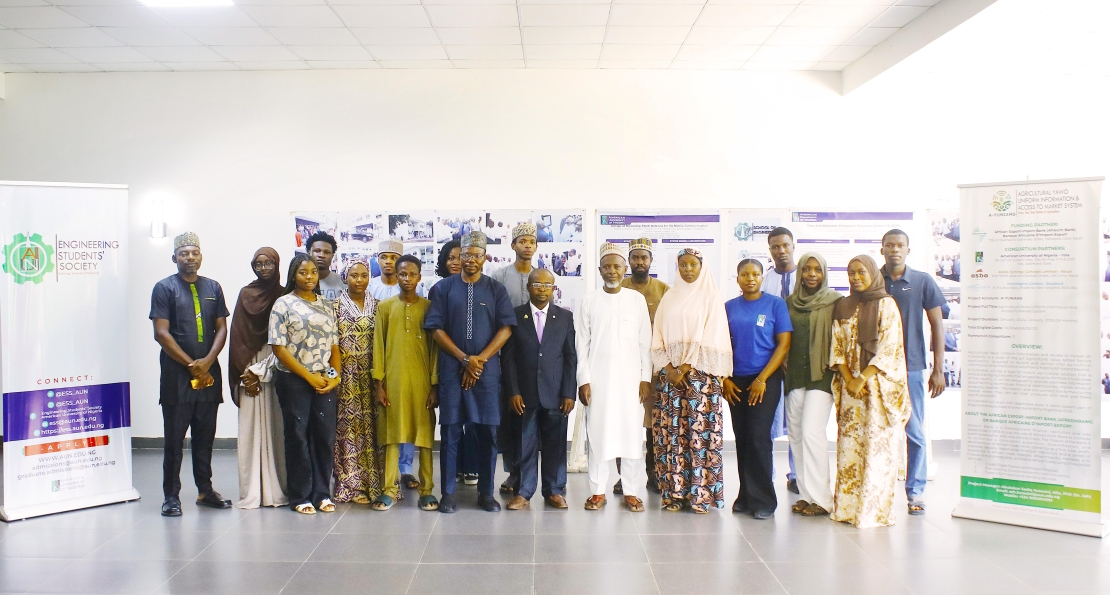
Engineering students preparing to graduate from the American University of Nigeria (AUN) received practical advice on building successful careers, with industry professionals urging them to look beyond academic qualifications and develop the skills needed to solve real-world problems.
The advice came during Life After Graduation: Beyond the Degree, a career preparation program organized by the Engineering Students’ Society on Friday, October 16, 2026, at the School of Engineering. Speakers drew on their professional experiences to discuss career opportunities, workplace expectations, and the challenges graduates may encounter as they enter the workforce.
Dalhat Yahaya Dalhat, the Society’s public relations officer, reminded students that “graduation is not the end of the journey; it is the beginning of another chapter.” He encouraged them to keep learning, ask questions, and take advantage of opportunities to prepare for life after university.
Prof. A. S. Grema, a project management professional at Heritage Energy Operational Services Limited and former Head of the Department of Chemical Engineering at the University of Maiduguri, shared his experience navigating academia and the oil and gas industry. He discussed opportunities in the upstream, midstream, and downstream sectors, as well as in entrepreneurship, consulting, and academia. “Learning and adaptability are the two key things that helped me transition,” he said. He also highlighted the importance of people-management skills in project management.
Building on the importance of adaptability, Engr. Ezinwa Michael Chinedu, principal engineer at Voice of Nigeria, urged students to focus on practical problem-solving rather than relying solely on their academic credentials. “Engineering is about solving problems, not simply earning certificates,” he told them.
Comparing a degree to a learner’s permit and life after graduation to a driver’s license, Chinedu explained that engineers develop professional competence through hands-on experience. He discussed redundancy in power systems, the use of artificial intelligence in network monitoring and problem-solving, and how the National Youth Service Corps (NYSC) year can provide valuable technical experience.
He also cautioned students against taking safety for granted, stressing the need to remain calm under pressure because mistakes on engineering sites can cost lives.
Engr. Sumaila Muhammad, a civil engineer and reinforcement supervisor at a construction firm in Adamawa, highlighted the skills and professional values students would need to build their careers. He identified four essential skills: critical thinking, creativity, collaboration, and communication. “As a problem solver, you should provide jobs for others, not just seek jobs,” he said, encouraging students to consider entrepreneurship alongside conventional employment.
Drawing on his experience in construction, Muhammad urged students to respect experienced field workers and communicate effectively with people from different professional backgrounds. He also stressed the importance of integrity, quality workmanship, and sound professional judgment, recounting a dispute involving a client and retaining-wall reinforcement to illustrate the need for accountability.
As he noted, “one job can give you a hundred jobs when well done,” emphasizing how quality work can build a professional reputation and lead to further opportunities.
Aishatu Zubairu Adamu, president of the Engineering Students’ Society, encouraged students who were unsure of their next steps to consider postgraduate study and familiarize themselves with relevant professional bodies before graduation. These include the Council for the Regulation of Engineering in Nigeria (COREN), the Institute of Electrical and Electronics Engineers (IEEE), and the Nigerian Society of Engineers.
Reported by Joshua Joy Jiya