

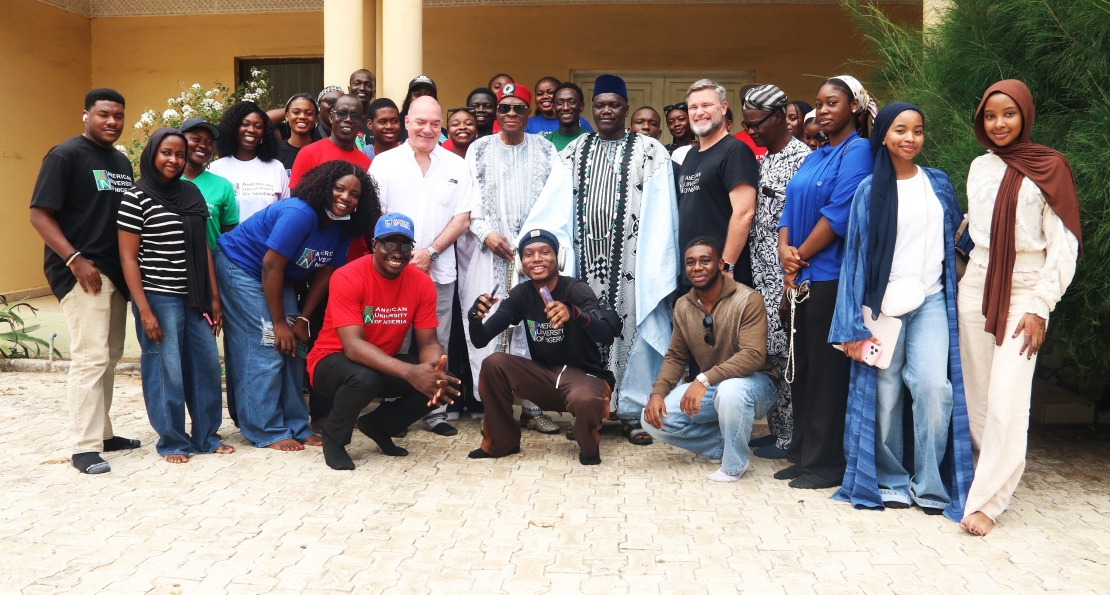
A challenge to explore Kiri Dam’s potential for sustainable energy generation emerged as a defining moment of an American University of Nigeria (AUN) expedition led by President Prof. DeWayne Frazier. The journey through Demsa, Numan, and Shelleng connected students with Adamawa State’s development priorities, cultural heritage, and religious history, demonstrating how learning beyond the classroom can deepen their understanding of the communities they will serve.
At the Hama Batta Palace in Demsa, the Batta monarch, His Royal Majesty Homun Alhamdu Gladstone Teneke, challenged AUN to explore the energy potential of nearby Kiri Dam. Welcoming the university delegation alongside His Royal Majesty, Kwandi Nunguraya Dr. Kuruhaye Dishon Dansanda II, the monarch stressed the importance of reliable electricity to industrial growth, economic activity, and improved livelihoods. He urged the university to consider how research and innovation could help address the region’s energy challenges.
In his remarks, His Royal Majesty Dr. Dishon commended AUN’s Founder, His Excellency Atiku Abubakar, for establishing a university that combines academic excellence with character development. He praised the institution for nurturing students who distinguish themselves through both academic achievement and personal conduct. His remarks reinforced the importance of an educational philosophy that develops intellect and character, preparing young people to contribute meaningfully to society.
Responding to the traditional leaders, Prof. Frazier reaffirmed AUN’s founding commitment to development-focused education and its responsibility to prepare graduates who can apply their knowledge to real-world challenges. The exchange underscored the value of collaboration between universities and traditional institutions in identifying community needs and exploring practical solutions.
From Demsa, the students travelled to Numan to explore another dimension of Adamawa’s heritage. At the Numan Central Roundabout, they learned about Makwada, the 19th-century warrior remembered in local history for defending his people against regional conquests. The commemorative monument offered an opportunity to reflect on how historical figures, oral traditions, and public landmarks preserve collective memory and strengthen cultural identity.
The journey continued at the headquarters of the Lutheran Church of Christ in Nigeria (LCCN). Guided by Mr. Ezra Zaccheaus, Secretary of St. John’s Cathedral, the students toured the historic church structure associated with Dr. Niels H. Brønnum. The visit drew attention to the role of Christian missions in advancing education, healthcare, and community life in northeastern Nigeria, providing further insight into the influence of religious institutions on the region’s social history.
The final stop was Kiri Dam in Shelleng Local Government Area, where the energy challenge raised at the Hama Batta Palace met the realities of major infrastructure. Under the guidance of Project Manager Mr. Umar Ahmed Mohammed, the students learned about the facility, constructed between 1977 and 1982, and its roles in flood control, irrigation, and fishing.
Beyond these functions, the dam’s expansive reservoir and surrounding landscape offer possibilities for exploring responsible tourism. Its potential for energy generation and tourism raises broader questions about how existing infrastructure could support economic activity while meeting technical, environmental, and sustainability requirements.
By bringing students into direct contact with traditional leadership, cultural and religious heritage, and critical infrastructure, the expedition demonstrated the value of experiential learning in understanding Adamawa State’s challenges and opportunities. It also reflected AUN’s development-university philosophy: preparing students to apply their knowledge, integrity, and professional skills to the needs of the communities they serve.
Reported by Fila Bitrus