

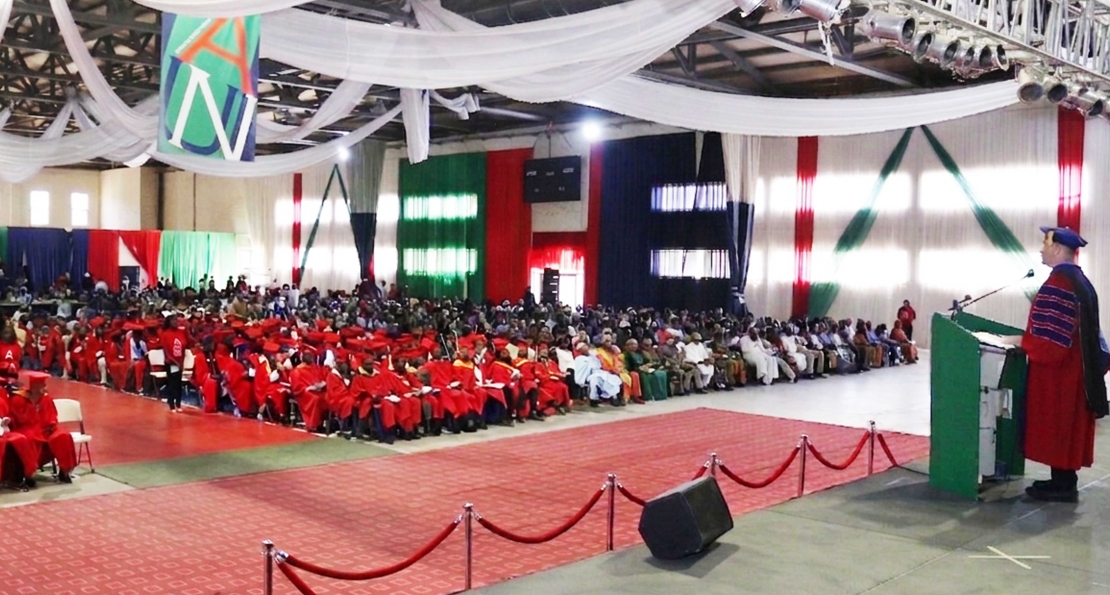
The American University of Nigeria (AUN) held its 2026 Commencement Ceremony on May 9, 2026, at the Lamido Aliyu Musdafa Commencement Hall, bringing together national leaders, university leadership, faculty, staff, alumni, parents, and other distinguished guests to celebrate the achievements of the graduating class and reflect on the institution’s evolving mission of education and service.
Speaking at the event, Prof. DeWayne Frazier, President of the American University of Nigeria, described the ceremony not as an endpoint, but as the beginning of a new intellectual and civic journey for graduates. He emphasized that commencement represents a transition into responsibility, leadership, and lifelong learning. “The word commencement means we are sending our graduates forward, forward into a new world with the tools, skills, and persona to be future leaders,” he said, underscoring AUN’s commitment to developing graduates who are adaptable, reflective, and globally engaged.
He reiterated that learning does not end with graduation but continues as a lifelong pursuit that shapes both personal development and public contribution.
Prof. Frazier paid tribute to the university’s Founder, H.E. Atiku Abubakar GCON, describing him as a visionary whose personal trajectory reflects resilience and national service. He recalled the Founder’s journey from humble beginnings in Jada to national leadership, noting that his vision led to the establishment of Nigeria’s first American-style development university.
He described AUN as a living expression of that vision, an institution grounded in the belief that education can fundamentally reshape the trajectories of individuals, communities, and nations.
Over time, he noted, AUN has evolved from a modest institution in Yola into a globally engaged university whose graduates contribute across sectors including technology, governance, entrepreneurship, advocacy, and academia. “From engineers in Silicon Valley to graduate students at Oxford, and young leaders shaping governance at home, our graduates are making impact without limits,” he said, describing the graduating class as prepared to engage complex global and national challenges.
Reflecting on the 2025/2026 academic year, Prof. Frazier described it as one of the most consequential in the university’s recent history, marked by institutional expansion, improved student experience, and strengthened academic delivery. He cited record enrollment, expanded academic programs, and enhanced student services as indicators of sustained progress.
He also highlighted several institutional developments, including the launch of the AUN 360 mobile application, modernization of the university health clinic, upgrades to residential and dining facilities, expansion of digital learning infrastructure, improved campus security systems, and ongoing energy efficiency initiatives.
Prof. Frazier further emphasized AUN’s expanding international engagement through partnerships with organizations such as the Tony Elumelu Foundation and Purdue University, alongside collaborations with global institutions including the U.S. Department of State, UNFPA, UNESCO, and ActionAid. He noted that these partnerships continue to extend AUN’s academic reach and developmental impact across Africa and beyond.
Reaffirming the university’s commitment to service, he commended students for their sustained engagement in community initiatives, noting that they contributed more than 1,000 hours of service during the semester. These efforts included tutoring programs, medical outreach, humanitarian projects, and the Feed & Read initiative. “We are a private university with a public mission,” he said, emphasizing that AUN’s identity extends beyond academic instruction to active civic engagement.
A particularly significant moment of the address came as Prof. Frazier reflected on the graduation of 12 Chibok girls previously abducted by insurgents. He described their achievement as a profound testament to resilience, recovery, and human dignity. “For many years, our cry was ‘Bring Back Our Girls,’ but today, we say with joy: we send our girls forward,” he said.
He added that their graduation stands as both a personal milestone and a broader affirmation of education as a force for restoration and hope.
He further declared their journey a symbolic rejection of extremist ideology. “Boko Haram means Western education is forbidden, but today we stand in defiance, NOT ON THIS DAY. Western education is not forbidden.”
Prof. Frazier reflected personally on the emotional weight of the moment, noting that the achievement carried deep meaning for families, educators, and the broader university community.
He concluded by reaffirming AUN’s guiding philosophy of “Education plus Service,” describing the institution as one committed to developing leaders who combine intellectual rigor with civic responsibility. He expressed gratitude to the Founder, the university community, and partners, and offered prayers for the graduating class as they embark on the next phase of their lives.
Reported by John Abah