

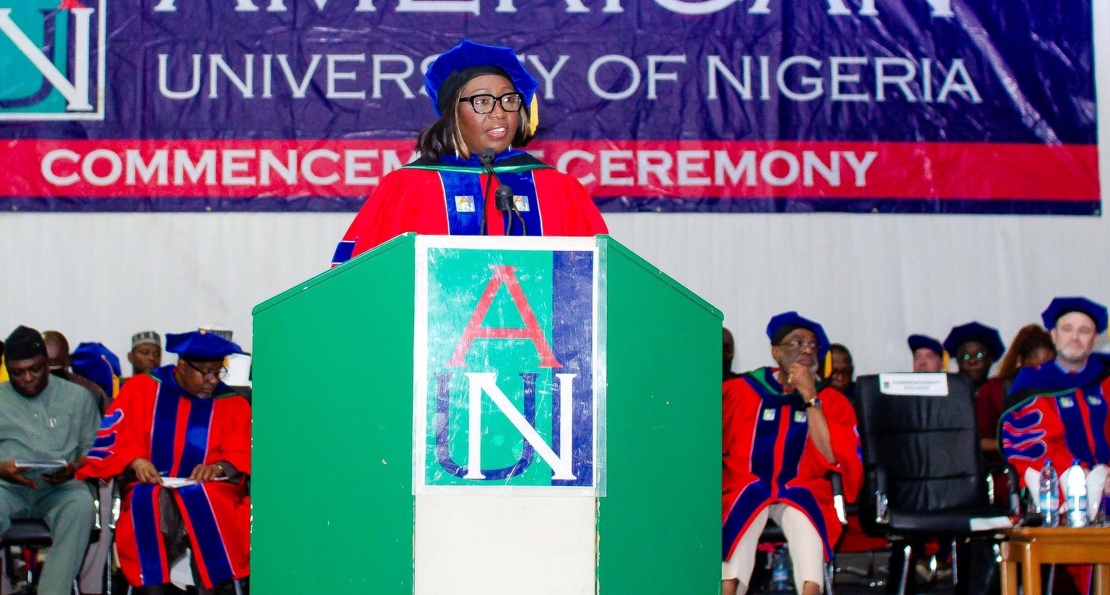
The 17th Commencement Ceremony of the American University of Nigeria (AUN), Yola, held at the Lamido Aliyu Musdafa Commencement Hall, featured a reflective and intellectually grounded address by Emmy and Peabody Award-winning journalist Stephanie Busari on May 9th, 2026. Her remarks situated graduation within broader themes of resilience, memory, and the enduring value of education.
Addressing graduates, faculty, families, and guests, Busari described it as “a real privilege” to speak to the Class of 2026, commending the institution and its leadership for fostering what she termed “the calibre and quality of students graduating from this institution today.”
She framed graduation not as a singular moment of arrival, but as the culmination of sustained perseverance. “Every person in this room receiving a degree today has had to push through something,” she observed, noting that while individual experiences varied, shared struggle defined the academic journey.
Busari acknowledged the often invisible dimensions of student experience, noting that some graduates faced visible hardships while others carried private burdens. “Some of you questioned whether you belonged here and chose to stay anyway,” she said, underscoring persistence, not ease, as the defining pathway to completion.
She cautioned graduates against allowing their achievements to be reduced to simplified external narratives. In professional and public spaces, she noted, complex journeys are often condensed into brief descriptors such as CV lines or job titles. “Do not let someone else’s limited imagination become your limit,” she advised.
Reinforcing the significance of the degree conferred, Busari described it as more than academic certification. “Your degree is only the first rung on the ladder you will climb in your lifetime,” she said, characterising it as enduring evidence of the capacity to sustain effort through difficulty.
A substantial portion of her address focused on the 12 Chibok schoolgirls among the graduating cohort, survivors of the 2014 abduction that remains a defining moment in Nigeria’s contemporary history.
Busari, who played a key role in international reporting on the Chibok kidnappings, reflected on her investigative work, including the acquisition of a “proof-of-life” video that helped sustain global attention during a critical phase of the crisis. “We did it because the alternative was silence, and silence felt like complicity,” she recalled.
She recounted meeting some of the girls following their release in 2017, noting the contrast between their fragile physical condition and their emotional presence. “They were thin, painfully so,” she said, “but they were wearing bright and bold Ankara outfits… and they were smiling, not for the cameras, but genuinely, with their whole faces.”
Referencing Psalm 126, she situated their return within a broader moral and historical frame: “When the Lord turned again the captivity of Zion, we were like them that dream.” She described the moment as one marked by disbelief, relief, and quiet restoration.
Addressing the Chibok graduates directly, Busari highlighted the symbolic weight of their academic achievement. “You were taken by people who believed your education was a threat worth eliminating,” she said, adding that their return and graduation stand as a direct refutation of that belief. “What they failed to understand is that once that power takes root in a person, it cannot be removed by force.”
She characterised their journey not only as survival, but as a sustained act of defiance. “What stayed with me was not what people often call resilience,” she said, “but refusal, a refusal to be forgotten.”
Extending her remarks to the wider graduating class, Busari emphasised the shared discipline underlying their academic completion. “You made the same decision, to stay, to push through, to finish,” she said. “That stays with you. It is what you will draw upon in the difficult moments that lie ahead.”