

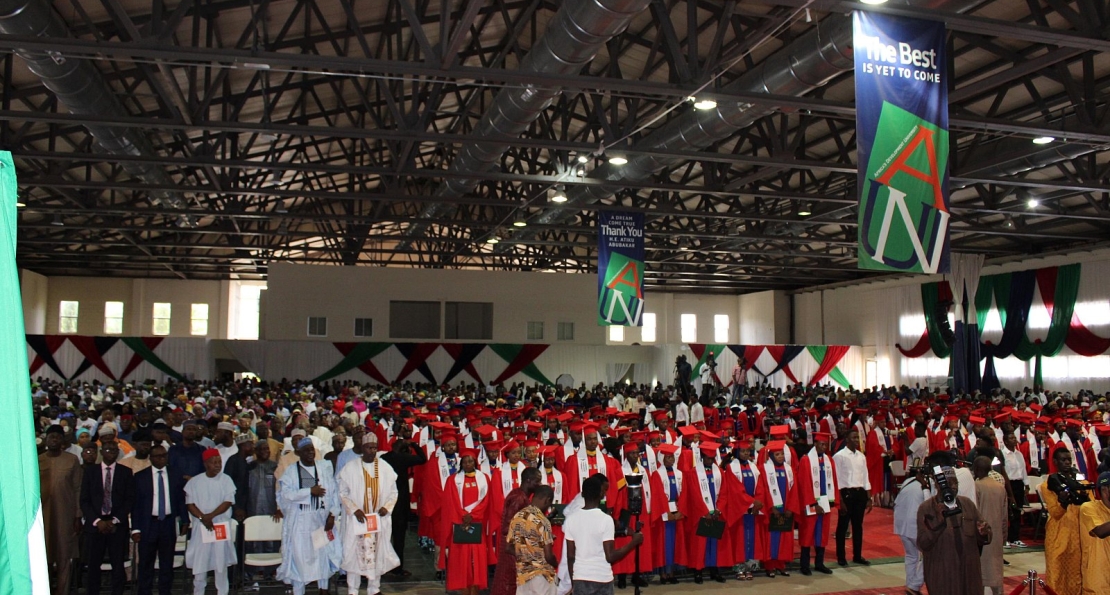
On May 9, 12 young women once defined by captivity will walk across the commencement stage at the American University of Nigeria—an image that once seemed almost impossible. What began as a rescue from unimaginable trauma has grown into one of the most powerful stories of educational impact in contemporary Nigeria.
On May 9, 2026, the American University of Nigeria (AUN) will graduate 12 additional Chibok girls at its 17th Commencement ceremony, marking not merely a celebration of academic success, but the visible outcome of nearly a decade of intentional investment in healing, empowerment, and human potential.
For these young women, education did not simply resume interrupted dreams; it rebuilt lives. What once seemed like a future permanently altered by insurgency has, through sustained institutional support, become a story of transformation defined by resilience, opportunity, and achievement.
Since first welcoming an initial group of 24 Chibok girls in September 2017, and later receiving an additional 106 young women in 2024 after they regained their freedom, AUN has built an intervention model that extends far beyond classroom instruction. The university’s approach has centered on long-term recovery through education, psychosocial support, and skills development.
The immediate impact began with stabilization. Upon arrival, the students were enrolled in the AUN New Foundation School (NFS), where they received intensive academic preparation for national examinations such as WASSCE and NECO. Yet the true significance of the initiative lies in its holistic structure.
A multidisciplinary support team of tutors, psychologists, sociologists, and medical professionals worked closely with the students to help them recover emotionally, socially, and academically. By providing safe accommodation, structured learning spaces, digital tools, daily meals, and financial support, AUN created an environment where healing and academic progress could occur simultaneously.
Among the beneficiaries of the initiative, 30 students progressed into full undergraduate degree programs after successfully completing their preparatory studies and passing the Unified Tertiary Matriculation Examination (UTME). Their academic paths now span disciplines including Public Health, Communication and Multimedia Studies, Business Administration, Accounting, Law, and International and Comparative Politics.
The graduation of 12 students this year represents the largest single batch of Chibok girls to graduate at once since the university began the initiative. More significantly, it reflects the success of a recovery model that has translated support into real academic milestones.
Thirty-seven others pursued vocational pathways, acquiring practical skills in bead-making, hairdressing, catering, fashion design, crocheting, and beauty services. These competencies have created immediate opportunities for self-reliance, entrepreneurship, and financial independence—critical indicators of sustainable empowerment.
In addition, 37 participants in specialized training tracks will receive certificates in public speaking, entrepreneurship, and communication skills, further strengthening their readiness for professional and civic engagement.
Jummai Paul, one of the graduating students, sees her degree not only as personal success but as a platform for influence.“ I hope to see myself casting news on national and international television. I also hope to use the skills I gained here to tell my personal story and serve as motivation to other girls who have experienced similar situations.”
Her words reflect one of the most profound outcomes of the initiative: a shift from survival to agency.
For Saratu, the impact of that opportunity is visible in how she now imagines her future.“I want to see myself in a hospital using the knowledge I gained at AUN to help people. I also hope to become a doctor in the future.”
These ambitions are themselves evidence of impact—the restoration of vision, confidence, and long-term purpose.
For AUN, the significance of this moment lies in what it says about the role of institutions in post-conflict recovery. The university has demonstrated that education can function as a transformative intervention, one capable of restoring dignity, rebuilding confidence, and opening pathways to leadership and economic participation.
AUN President Prof. DeWayne Frazier underscored this significance in his message to the graduating class. “Graduation is not just an end, but a beginning—our students leave here prepared to lead, serve, and make meaningful impact in the world.”
Indeed, the broader impact of this initiative is not limited to the graduating students alone. It extends to families, communities, and the national conversation on recovery, women’s education, and resilience in the face of extremism.
This story is therefore not only about what happened to the Chibok girls. It is about what became possible because opportunity met resilience.
As 12 more young women prepare to cross the commencement stage, their journey stands as one of the most compelling examples of how education can alter the trajectory of lives once defined by tragedy.
From captivity to commencement, AUN’s intervention has become more than an institutional initiative; it stands as proof that education does more than restore lost time—it restores futures.
By John Abah