

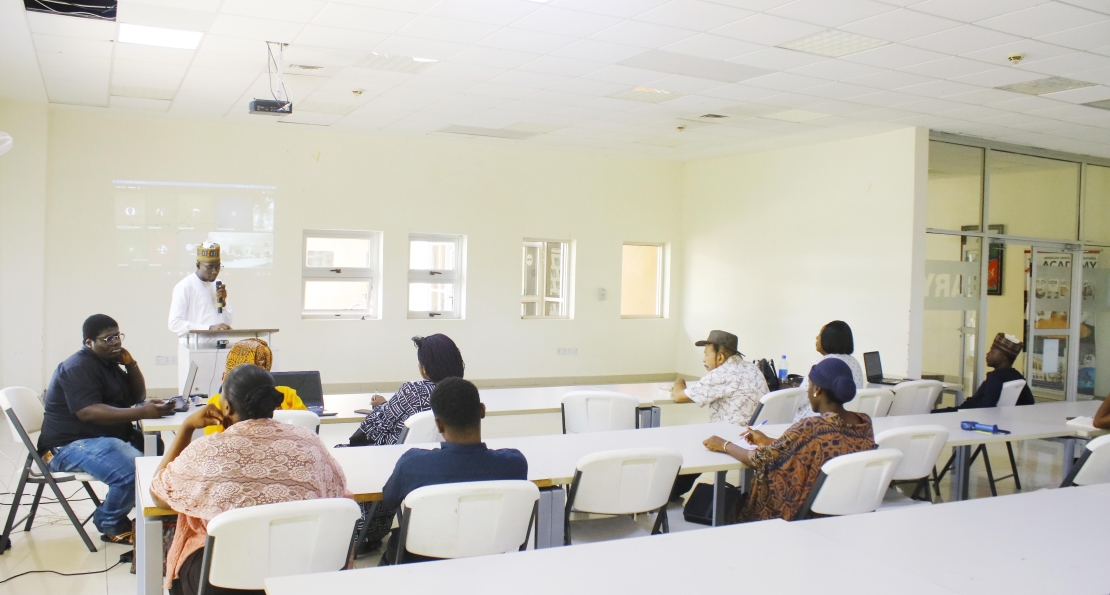
Universities play a vital role in preparing graduates to do more than acquire knowledge; they must also help them think critically, tackle unfamiliar problems, and develop practical solutions. This was a central message at a seminar hosted by the Teaching and Learning Center (TLC) of the American University of Nigeria (AUN), Yola, on October 16, 2026.
Held at the AUN 24-Hour Library Space, the seminar featured Dr. Tesleem Babatunde Asafa, a professor of mechanical engineering at Ladoke Akintola University of Technology (LAUTECH) and Director of Emerging Skills and Technology (CEST) at the Seyi Makinde Innovation and Technology Hub.
During his presentation, Dr. Asafa discussed practical ways lecturers can incorporate open-ended problem-solving into their teaching. He highlighted inquiry-based learning, interdisciplinary projects, design thinking, and digital technologies as approaches that encourage students to apply what they learn, explore new ideas, and respond to real-world challenges.
He linked these methods to Outcome-Based Education (OBE), drawing examples from different engineering fields to show how problem-solving can support Nigeria’s development priorities. He also outlined the key stages of the process, from identifying and defining a problem to exploring possible approaches and developing workable solutions.
Dr. Asafa acknowledged, however, that putting these approaches into practice can be challenging. Crowded syllabuses, limited equipment, large classes, students’ uncertainty, lecturers’ workloads, and assessment concerns can all hinder their adoption. He urged universities to address these challenges and keep their curricula responsive to changing technologies and societal needs.
Emphasizing the connection between knowledge and innovation, he stated, “Knowledge is the foundation, inquiry is the methodology, evidence is the discipline, and innovation is the possibility.” He cautioned that universities would struggle to sustain open-ended problem-solving if their curricula did not evolve with changing needs.
The discussion reinforced the importance of STEM education in developing independent thinkers who can turn knowledge into practical solutions. This approach aligns with AUN’s commitment to experiential learning and its broader mission to prepare graduates to address societal challenges and contribute to national development.
At the close of the seminar, Dr. Agatha Ukata, Director of the Teaching and Learning Center and Interim Dean of the School of Arts and Sciences, delivered the vote of thanks. She expressed appreciation to Dr. Asafa, the moderator, and all participants for their contributions to the seminar.
Through its seminars and other faculty-development initiatives, the Teaching and Learning Center continues to encourage teaching practices that help bridge the gap between classroom learning and the practical challenges students will face after graduation.
By Udoh Victoria Clement
Faculty Engagement